

The dimension of the risk
Risks associated with agricultural food production can have an impact on both producers and consumers today. Coherent and integrated long-term plans and policies are needed to lower risk aversion and boost resilience among African rural farmers in order to improve investment and achieve a sustained increase in production. Additionally, it is imperative to acknowledge the vital significance of social protection and how it enhances risk management programs.
Lack of a scientific approach
Market-based strategies are essential for risk management alternatives to succeed, however the investigated nation experiences have shown that most risk management tools are either nonexistent or underdeveloped in Sub-Saharan Africa. The fact that farmers are vulnerable to shocks to output and prices highlights the crucial role that governments play in managing agricultural risk.
African governments must take an integrated, comprehensive strategy to supporting risk management initiatives through incentives, as well as by bolstering agricultural markets and financial institutions, given the strong correlation that exists between output, pricing, and market risks. The New Partnership for Africa’s Development Planning and Coordination Agency is actively advocating for the mainstreaming of risk management technologies into agricultural policies and programs.
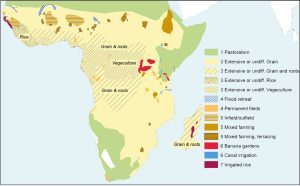

Underperformance
Sub-Saharan Africa’s agricultural output has been consistently lower than that of the rest of the world in recent years. A lot of people blame this effect on things that are specific to Africa and its people, like the climate, the quality of the soil, and sickness. These systems were altered by outside meddling in an effort to produce export crops.
This food status has not fundamentally changed today despite independence; the extraction of wealth and resources still prevents Africans from developing economically within their own continent.
Meaningful insights required
Finding solutions that improve farmers’ ability to adapt would require a deeper knowledge of how smallholder farmers see and manage risks. We looked into a wide variety of risks that affect farmers’ decision-making. Opportunities and limitations differ depending on how well-equipped farms are with resources in Mali’s cotton zone. Furthermore, intra-household variety may have an impact on perceptions and risk management because families in this region are big, typically consisting of 20–50 family members.
Case studies
A poll including 250 individuals from 58 households and focus group talks were used to collect information. The assessment of risk involved evaluating the interplay between the perceived frequency of dangers and their influence on food supply and income. Farmers had to deal with a variety of dangers, the most serious of which were those pertaining to personal and animal health as well as climate variability.
Gender was not a determinant in differences within the household; rather, it was the generational aspect and decision authority. Decision-making members of the household were more concerned about hazards. Nearly 25% of the dangers that were mentioned had a high frequency and a high impact.
Solutions
Compared to other farm types, food production systems today with limited resources were more frequently exposed to high hazards. Farmers used a range of strategies to deal with risks, but frequently they had no answer at all. Medical interventions focused on risks to the health of people and animals.
A variety of risks were created by altered consumption rates, calls for social contacts, and modifications to field and animal management procedures. Our findings imply that, in order to improve social well-being and agricultural productivity, development interventions should integrate both agronomic and economic possibilities.